
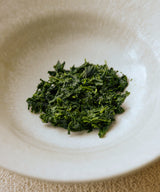


Yame Gyokuro "Jun"
Yame is a special place. It is defined by dramatic mountains and cascading waterfalls. It is also known to produce the best Gyokuro in Japan, making it home to the traditional craftsmanship for this kind of tea. Over 100 years of experience making Gyokuro lives in Yame and thus, the tea that comes from here has set the standard for Gyokuro around the world.
Gyokuro depends on shade, and the best ones are grown in the valleys of mountains where there is little direct sunlight. The narrow river valleys of the Yame region create the ideal conditions for these tea trees, and they are able to flourish naturally, without much human intervention.
Unique to the making of gyokuro is that, at a certain point in the growth of the tea plants, the entire field is covered with screens designed to filter out even more light. Roughly 2 to 3 weeks before harvest, large straw screens that are woven locally are stretched between a lattice of concrete pillars and suspended above the tea fields. To our knowledge, Yame is the only region that still uses this traditional shading method. The standard practice elsewhere is to use synthetic fiber to shade the trees, which works similarly, but has the undesired effect of raising the temperature in the tea field, thereby diminishing the quality of the tea.
The shading of the tea field step stresses the trees, causing them to strive for sunlight, and therefore increases the amount of L-theanine in their leaves. Their striving is what gives gyokuro its distinct mouthfeel, nutritional properties, and rich flavor.
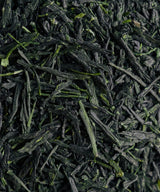
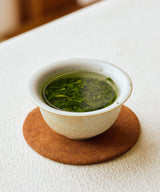
The first thing we notice about this gyokuro is its almost oily smell. Its first long infusion has a bitterness that draws us forwards first, followed by a dense, round mouthfeel that pulls us back and downwards. This tea's ability to activate us is very legible on the palate, and it extends a watery sense of movement throughout the entire body.
Following infusions are still dense on the palate. Gradually its salinity recedes, while a pleasant florality emerges, all the while rocking us backwards and forwards.