



Huoqing "Fire Jade" 2026
This unusual tea is specific to Huangtian, an ancient village in Anhui Province, situated in a fertile valley along the Yangtze River in Southeastern China. Huangtian is a vital place that maintains many long standing traditions. It is famous for handmade paper and its unique architecture: all of the structures have white, concrete walls and black tiles. It is also famous for the craftsmanship of this particular kind of green tea.
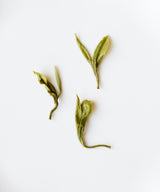
Huangtian and the village Yongxi, on the other side of the mountain, are the birthplace of Huoqing 火青, or "fire green" tea. Tea making here began in the 1500's, during the Ming Dynasty and the area is still home to many century-old indigenous tea trees. The soil in this rocky area is particularly dense, giving the tea leaves intense flavour and strong energy. These semi-wild trees thrive on their own, in the valley between two mountains, and are only harvested once a year, in Spring.
It takes both knowing and endurance to reach the wild tea trees scattered throughout the area. The most remote ones are 20 kilometers from the village, and it requires a 3 hour hike into the mountains to access them. Usually, the elders will trek out in the early morning, bringing lunch with them, and return to the village with freshly harvested tea leaves in the late afternoon. The best tea leaves are the ones further from the village, and that receive less direct sunlight. However, there are less and less people willing to make this trek, which means that the best Huoqing teas are slowly disappearing.
This profound effort to harvest is matched in the craftsmanship of Huoqing; it is one of the most labour-intensive green teas we are aware of, requiring extreme patience, skill and experience. Crafting Huoqing involves 20 hours of continuous pan-frying over charcoal. Traditionally, making one batch of tea meant dividing the 20 hours of pan frying into three, 7 hour shifts split between three people. This Huoqing is crafted by Mr. Zhu, who is now in his seventies. He has been a tea farmer and a beekeeper all his life.
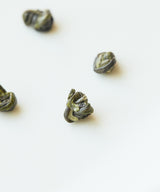
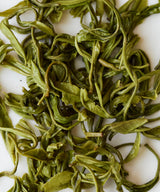
Mr. Zhu began learning how to make tea with local elders when he was 16 years old. As an apprentice to the master craftsmen, he spent 2 years washing the iron woks that were used to pan fry the green tea. Gradually, he learned how to craft Huoqing tea by hand on his own, mastering the subtle motions that transform the fresh leaves into the tightly rolled balls we see in the finished tea. The tea must be continually moved every minute of the 20 hours that it is in the wok, otherwise the leaves burn. Because of how labour intensive it is. Mr. Zhu and his wife only make 50kg of Huoqing green tea each year.
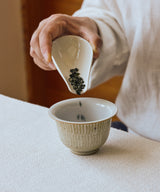
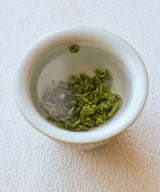
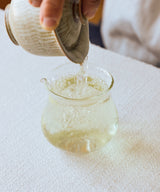
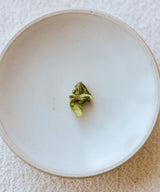
This tea has a strong presence. After 20 hours of gentle roasting, when it finally comes out of the iron wok, the tea has turned a deep, rich green, with a beautiful oily sheen. In the gaiwan they unfurl quickly into bright, youthful leaves that curve softly in the water. We first taste the warm, metallic "wok hay," followed by the intense greenness of the plant, then the wildness of the forest valley, and finally, its spring flowers.
Inflected by the extended, rhythmic pan frying process, this green tea presents with such depth and complexity it feels more like a pu-erh. Like a pu-erh, it is such a direct expression of the tea plant and its terroir and, also like a pu-erh, its energy moves evenly throughout the whole body. It has the aroma of freshly peeled tree bark, and the energetics of a wild terrain.
The best Huoqing tea leaves are found deep in the mountains of Huangtian. Tea plants that grow on the slopes closer to the village receive more hours of direct sunlight throughout the day, meaning the tea will have a weaker fragrance and lose depth. Tea trees that grow deep in the mountains receive more dappled sunlight, which makes for better tea.