

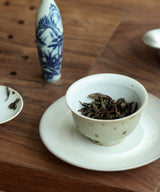
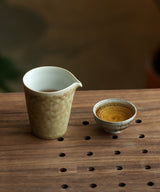


Yellow Rose
We consider Yellow Rose an experimental tea for a few reasons. One being that this rare varietal is a relatively new cross breed of two other oolongs, Huangguanyin (yellow cassia) and Huangdan, developed in 2002. Another being that, because this varietal is so delicate, its craftsmanship deviates from other True Cliff oolongs.
This new varietal earned such a pretty name on behalf of its extremely gentle and sweet florality. Being so delicate, the roasting process for it requires careful attention otherwise it will be overpowered. The leaves must be roasted over a specific wood charcoal that burns at a lower temperature, and for a longer period of time. Therefore, only a very experienced artisan can craft this tea.
This Yellow Rose was planted in the village of Wusandi 吴三地, 45km northwest of the Wuyi Mountain Nature Reserve. This is a famous tea village, situated at a relatively high altitude for the region, and famous for its Shuixian.
The entire community in Wusandi collectively maintains traditional and regenerative tea farming techniques. They benefit greatly from the fact that the older generations in their village did not cut down the tea trees and work to ensure this happens for generations to come. This shared understanding has meant that the Wusandi villagers have been able to preserve an incredible number of old grove tea trees — something that we rarely see in famous tea regions nowadays. Even more unusual is that, planted amongst them, is this strange new experiment, Yellow Rose.
Yellow Rose is fascinating for oolong drinkers, as the stronger characteristics we associate with this kind of tea are all softened. This gives way to the nuances of rock oolong's more gentle, floral characteristics. The "cliff" is still present, but these softened mineral notes come on the finish, after we've tasted something very sweet and intensely pretty.